Understanding the Pectoralis Minor: The Hidden Key to Shoulder Function and Posture
In the world of fitness and rehabilitation, much attention is given to muscles that visibly produce movement. Yet, beneath the surface lies a smaller, often overlooked muscle that plays a powerful role in how the body moves and functions—the pectoralis minor.
Though it does not dominate pressing strength like its larger counterpart, this deep muscle is essential for proper scapular positioning, breathing mechanics, and overall shoulder health. When understood and trained correctly, it becomes a gateway to improved performance and reduced injury risk.
Anatomical Foundation
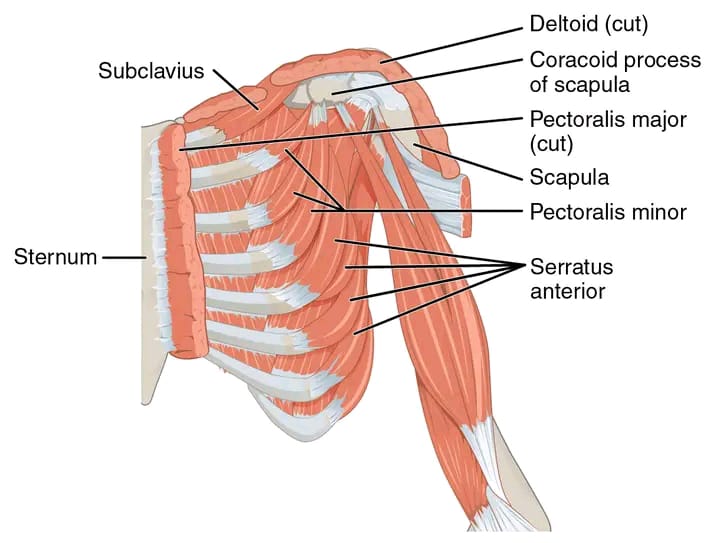
The pectoralis minor is a deep anterior scapular muscle located beneath the pectoralis major. It originates from the anterior surfaces of ribs 3 to 5, near the costal cartilages, and inserts into the medial border and superior surface of the coracoid process of the scapula.
This unique attachment gives it significant influence over how the scapula moves and rests on the rib cage, particularly affecting the scapulothoracic joint.
Mechanical Role and Fiber Orientation
The muscle fibers run upward and outward—from the ribs to the coracoid process. This direction of pull naturally creates:
Anterior tilt of the scapula
Protraction (forward movement)
Downward rotation (in certain conditions)
However, its behavior is not isolated. It is shaped by several interacting factors, including rib cage positioning, thoracic posture, breathing patterns, and coordination with surrounding muscles like the serratus anterior and trapezius.
Functional Importance
Primary Functions
Controls scapular anterior tilt
Assists in scapular protraction
Contributes to downward rotation
Supports rib elevation during breathing
Secondary Roles
Aids in scapular stability when balanced
Influences respiratory efficiency
Helps maintain proper shoulder girdle posture
Rather than being a force generator, the pectoralis minor acts as a positional regulator—setting the stage for efficient movement.
Impact on Movement and Performance
The pectoralis minor does not directly power pressing movements, but it determines the starting position of the scapula. This positioning affects:
Glenoid alignment
Subacromial space
Scapular tilt balance
Efficiency of stabilizing muscles
When the scapula is poorly positioned, even the strongest muscles cannot perform effectively. This is why many individuals struggle with pressing exercises despite having adequate strength—the issue lies in positioning, not power.
Common Dysfunctions
When the Pectoralis Minor is Tight or Overactive
Rounded shoulder posture
Excessive scapular anterior tilt
Reduced subacromial space
Limited overhead mobility
Result:
Increased risk of shoulder impingement
Poor serratus anterior activation
Dominance of chest muscles with reduced control
When Poorly Integrated
Loss of posterior scapular tilt
Altered breathing patterns
Rib cage elevation bias
Reduced movement efficiency
It’s important to note that dysfunction is not only about tightness. Poor neuromuscular control is equally significant.
Training Principles for Balance and Function
1. Avoid Over-Isolation
The goal is not to directly “train” the pectoralis minor but to restore balance within the system.
2. Strengthen Opposing Muscles
Focus on:
Serratus anterior
Lower trapezius
Thoracic extensors
These muscles help counteract excessive anterior tilt and improve scapular control.
3. Integrate Breathing
Proper breathing mechanics are essential. Training should:
Improve rib cage positioning
Reduce rib flare
Reinforce diaphragm function
4. Combine Mobility with Control
Stretching alone is not enough. Mobility must be paired with active control to create lasting change.
5. Re-educate Posture
Training should emphasize:
Proper scapular alignment
Neutral positioning under load
Awareness during movement
Progression Strategy
Regression Approaches
Passive release techniques
Supported thoracic extension drills
Breathing-based repositioning exercises
Progression Techniques
Serratus-driven protraction drills
Integrated pushing patterns
Loaded scapular control exercises
This structured approach ensures both correction and performance improvement.
Final Insight
The pectoralis minor may be small, but its influence is profound. It does not create movement—it shapes it.
When dominant, it pulls the body into dysfunction
When balanced, it allows optimal alignment and efficient force transfer
True shoulder health is not built on strength alone, but on harmony between key muscles:
Pectoralis Major → Force production
Serratus Anterior → Stability and control
Pectoralis Minor → Positional guidance
Together, they define not just how you train—but how you move, breathe, and perform.
About the Author
Kareem Blinder is a certified fitness coach with over 20 years of experience helping individuals move better, recover faster, and transform their bodies.
Specialties include:
Corrective and functional training
Post-injury rehabilitation
Body composition transformation
His philosophy is simple: train smarter, not just harder—so you can achieve lasting results without unnecessary strain or injury.
If you're looking to improve your movement, restore balance, and build strength the right way, the journey starts with understanding your body—one muscle at a time.
In the world of fitness and rehabilitation, much attention is given to muscles that visibly produce movement. Yet, beneath the surface lies a smaller, often overlooked muscle that plays a powerful role in how the body moves and functions—the pectoralis minor.
Though it does not dominate pressing strength like its larger counterpart, this deep muscle is essential for proper scapular positioning, breathing mechanics, and overall shoulder health. When understood and trained correctly, it becomes a gateway to improved performance and reduced injury risk.
Anatomical Foundation
The pectoralis minor is a deep anterior scapular muscle located beneath the pectoralis major. It originates from the anterior surfaces of ribs 3 to 5, near the costal cartilages, and inserts into the medial border and superior surface of the coracoid process of the scapula.
This unique attachment gives it significant influence over how the scapula moves and rests on the rib cage, particularly affecting the scapulothoracic joint.
Mechanical Role and Fiber Orientation
The muscle fibers run upward and outward—from the ribs to the coracoid process. This direction of pull naturally creates:
Anterior tilt of the scapula
Protraction (forward movement)
Downward rotation (in certain conditions)
However, its behavior is not isolated. It is shaped by several interacting factors, including rib cage positioning, thoracic posture, breathing patterns, and coordination with surrounding muscles like the serratus anterior and trapezius.
Functional Importance
Primary Functions
Controls scapular anterior tilt
Assists in scapular protraction
Contributes to downward rotation
Supports rib elevation during breathing
Secondary Roles
Aids in scapular stability when balanced
Influences respiratory efficiency
Helps maintain proper shoulder girdle posture
Rather than being a force generator, the pectoralis minor acts as a positional regulator—setting the stage for efficient movement.
Impact on Movement and Performance
The pectoralis minor does not directly power pressing movements, but it determines the starting position of the scapula. This positioning affects:
Glenoid alignment
Subacromial space
Scapular tilt balance
Efficiency of stabilizing muscles
When the scapula is poorly positioned, even the strongest muscles cannot perform effectively. This is why many individuals struggle with pressing exercises despite having adequate strength—the issue lies in positioning, not power.
Common Dysfunctions
When the Pectoralis Minor is Tight or Overactive
Rounded shoulder posture
Excessive scapular anterior tilt
Reduced subacromial space
Limited overhead mobility
Result:
Increased risk of shoulder impingement
Poor serratus anterior activation
Dominance of chest muscles with reduced control
When Poorly Integrated
Loss of posterior scapular tilt
Altered breathing patterns
Rib cage elevation bias
Reduced movement efficiency
It’s important to note that dysfunction is not only about tightness. Poor neuromuscular control is equally significant.
Training Principles for Balance and Function
1. Avoid Over-Isolation
The goal is not to directly “train” the pectoralis minor but to restore balance within the system.
2. Strengthen Opposing Muscles
Focus on:
Serratus anterior
Lower trapezius
Thoracic extensors
These muscles help counteract excessive anterior tilt and improve scapular control.
3. Integrate Breathing
Proper breathing mechanics are essential. Training should:
Improve rib cage positioning
Reduce rib flare
Reinforce diaphragm function
4. Combine Mobility with Control
Stretching alone is not enough. Mobility must be paired with active control to create lasting change.
5. Re-educate Posture
Training should emphasize:
Proper scapular alignment
Neutral positioning under load
Awareness during movement
Progression Strategy
Regression Approaches
Passive release techniques
Supported thoracic extension drills
Breathing-based repositioning exercises
Progression Techniques
Serratus-driven protraction drills
Integrated pushing patterns
Loaded scapular control exercises
This structured approach ensures both correction and performance improvement.
Final Insight
The pectoralis minor may be small, but its influence is profound. It does not create movement—it shapes it.
When dominant, it pulls the body into dysfunction
When balanced, it allows optimal alignment and efficient force transfer
True shoulder health is not built on strength alone, but on harmony between key muscles:
Pectoralis Major → Force production
Serratus Anterior → Stability and control
Pectoralis Minor → Positional guidance
Together, they define not just how you train—but how you move, breathe, and perform.
About the Author
Kareem Blinder is a certified fitness coach with over 20 years of experience helping individuals move better, recover faster, and transform their bodies.
Specialties include:
Corrective and functional training
Post-injury rehabilitation
Body composition transformation
His philosophy is simple: train smarter, not just harder—so you can achieve lasting results without unnecessary strain or injury.
If you're looking to improve your movement, restore balance, and build strength the right way, the journey starts with understanding your body—one muscle at a time.