Kipchoge’s love for running emerged at a young age. Growing up in a community where running was part of everyday life, young Eliud would often run to and from school. It was here that the seeds of endurance and mental toughness were planted. In an interview, Kipchoge recalled, “Running is not just a sport; it is a way of life. Every run teaches you patience and discipline.” These qualities would become hallmarks of his legendary career.
His formal athletic journey began in track events, particularly the 5000 meters. Kipchoge quickly rose through the ranks, showcasing remarkable talent and consistency. In 2003, he won the Junior World Championships in the 5000 meters, signaling the arrival of a future star in the global athletics arena. By 2004, he had qualified for the Athens Olympics, winning a bronze medal in the 5000 meters—a remarkable achievement for an 18-year-old making his Olympic debut.
Kipchoge’s transition from track to marathon running was a calculated and masterful move. His debut marathon in Hamburg in 2013 saw him finish third, but it quickly became clear that the road would be his true domain. Over the next decade, Kipchoge redefined what was possible in long-distance running. He consistently pushed the boundaries, combining an almost scientific approach to training with a deep understanding of the mental aspects of endurance. His training in the high-altitude regions of Kenya, along with a disciplined lifestyle, played a crucial role in his rise to marathon supremacy.
One of Kipchoge’s most celebrated achievements came at the 2016 Rio Olympics, where he won the gold medal in the marathon. This victory cemented his reputation as a global force in distance running. Yet, perhaps his most groundbreaking accomplishment occurred on October 12, 2019, in Vienna, Austria, during the INEOS 1:59 Challenge.
Kipchoge became the first person in history to run a marathon in under two hours, completing 42.195 kilometers in 1 hour, 59 minutes, and 40 seconds. Although this feat was not recognized as an official world record due to the controlled conditions of the event, it was a monumental moment that captured the imagination of the world and showcased the limits of human endurance.
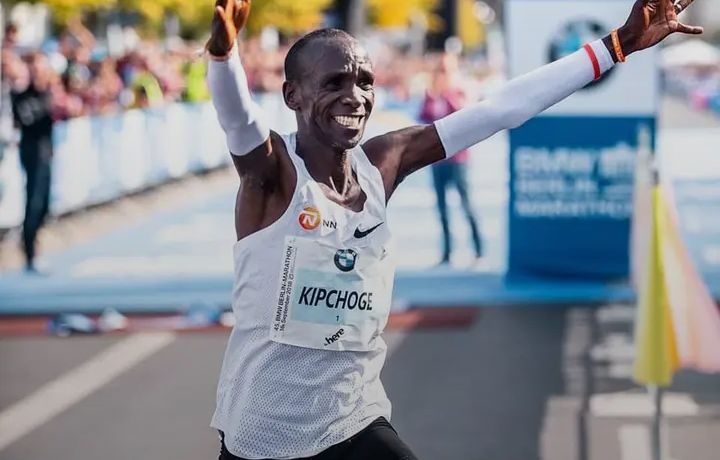
Kipchoge’s official marathon world record stands at 2 hours, 1 minute, and 9 seconds, set at the 2022 Berlin Marathon. This record-breaking run reinforced his dominance in the sport and highlighted his exceptional consistency. What makes Kipchoge truly extraordinary is not just his speed but his philosophy toward running and life. He is known for his humility, discipline, and a mindset rooted in continuous improvement. Kipchoge often emphasizes that “No human is limited,” inspiring athletes and non-athletes alike to strive for greatness regardless of the challenges they face.
Beyond records and medals, Kipchoge has become a symbol of dedication and inspiration. His influence transcends sports, as he advocates for education, sustainability, and personal development. In Kenya and around the world, Kipchoge’s story is a reminder that greatness is achieved not solely through talent, but through perseverance, discipline, and an unwavering belief in oneself.
Despite his global fame, Kipchoge maintains a grounded lifestyle. He lives simply, trains rigorously, and consistently credits his family, coaches, and community for his success. This balance between extraordinary achievement and humility has endeared him to fans worldwide, making him not just a champion on the track, but also a role model in life.
As Eliud Kipchoge continues his career, the world watches not just for the records he may break, but for the lessons he imparts about human potential. From a small village in Kenya to the world’s biggest marathon stages, Kipchoge’s journey is a testament to what can be achieved when talent meets discipline, focus, and an unyielding spirit. He has not only rewritten the record books but has also redefined the limits of human endurance, inspiring a generation to dream bigger, run faster, and believe in the impossible.