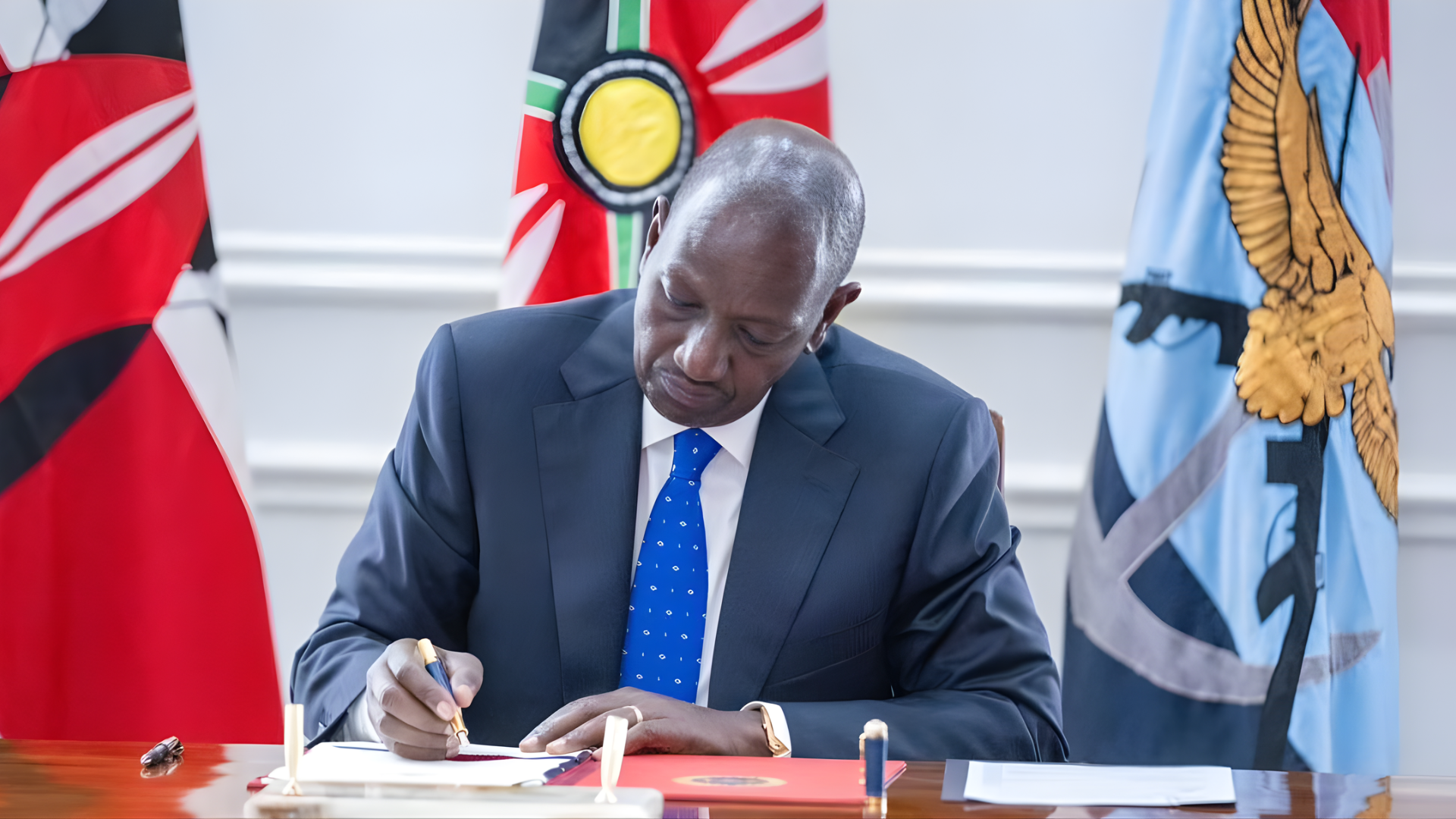
President William Ruto has signed two landmark pieces of legislation into law, marking significant steps in infrastructure financing reform and judicial welfare.
The National Infrastructure Fund Bill, 2026, establishes a dedicated KSh 5 trillion vehicle designed to shift Kenya’s infrastructure development from a predominantly debt-financed model to a sustainable, investment-led framework anchored on domestic capital markets and private-sector participation. The law creates the National Infrastructure Fund as a separate legal entity under the National Treasury, with governance structures that include a board of trustees, an investment committee and independent oversight mechanisms.
The fund will mobilise resources through a combination of initial seed capital, contributions from government revenues, pension funds, insurance companies, sovereign wealth vehicles, diaspora remittances and long-term institutional investors. It is empowered to issue infrastructure bonds, sukuk, blended-finance instruments and other capital-market products, as well as enter public-private partnerships and co-invest in priority projects across transport, energy, water, housing, digital infrastructure and social facilities.
The signing ceremony, held at State House on March 3, 2026, came just one day before the much-anticipated trading debut of Kenya Pipeline Company (KPC) shares on the Nairobi Securities Exchange. KPC’s initial public offering, which closed earlier this year, raised Sh106.3 billion—providing the single largest seed contribution to the fund to date. President Ruto described the twin events as “two sides of the same coin” in Kenya’s journey toward self-reliant infrastructure financing.
“Today we break the cycle of debt dependency,” Ruto said after appending his signature. “For too long we have borrowed heavily to build roads, ports, power plants and water systems, only to spend decades repaying with interest that could have funded more development. The National Infrastructure Fund changes that equation. It lets Kenyans invest in their own future, earn returns on those investments, and build assets that belong to the nation—not to foreign creditors.”
The President highlighted that the fund will prioritise bankable projects with clear revenue streams—such as toll roads, airports, ports, renewable energy plants and digital infrastructure—so that returns can be reinvested and the capital base grows over time. He also emphasised safeguards against mismanagement, including mandatory annual independent audits, publication of investment portfolios and parliamentary oversight.
The second bill signed into law—the Judges’ Retirement Benefits Bill, 2025—introduces a contributory pension scheme for judicial officers. Under the new framework, judges will contribute 7.5% of their basic salary while the government contributes 15%, creating a pooled fund that will finance monthly pensions, comprehensive medical cover (including post-retirement), enhanced security arrangements and other post-service benefits.
The legislation also grants judges lifetime diplomatic passports and access to government VIP lounges at all Kenyan airports, recognising the demanding nature of judicial service and the security risks that persist after retirement. “Judges carry an enormous burden,” Ruto said. “They interpret our Constitution, resolve disputes that shape society and sometimes make decisions that attract powerful enemies. This law ensures they retire with dignity, security and adequate support.”
The signing of both bills was witnessed by Chief Justice Martha Koome, Attorney-General Dorcas Oduor, National Assembly Speaker Moses Wetang’ula, Senate Speaker Amason Kingi, and leaders of the judiciary, Parliament and the executive. The President used the occasion to reiterate his administration’s focus on institutional strengthening.
“These two laws—one about building the physical backbone of our economy, the other about protecting those who guard our constitutional order—show that we are serious about sustainable development and the rule of law,” Ruto added. “We are investing in the future while honouring those who serve the nation today.”
The National Infrastructure Fund is expected to become operational within the next financial year once the required regulations and board appointments are finalised. KPC shares are scheduled to begin trading on the NSE tomorrow, March 4, 2026, with analysts projecting strong initial demand given the company’s strategic role in the energy sector and the symbolic importance of the IPO as seed capital for the fund.
The Judges’ Retirement Benefits Act takes effect immediately upon publication in the Kenya Gazette, with the first contributions scheduled to begin in the current payroll cycle.
Both pieces of legislation now move to the implementation phase, where their success will depend on effective governance, transparent management and sustained political will.