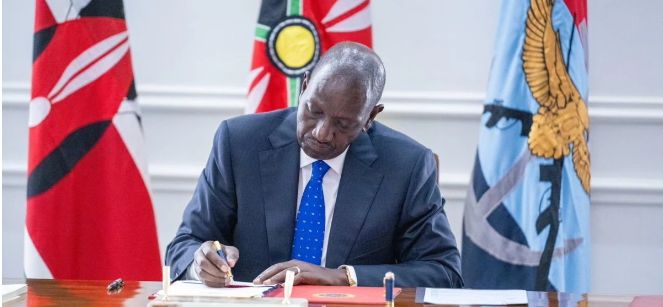
President William Ruto has signed the Ksh.5 trillion National Infrastructure Bill, 2026, paving the way for the expansion of Jomo Kenyatta International Airport (JKIA) and other key infrastructure projects. The bill aims to shift infrastructure financing towards an investment-led model, attracting private capital and reducing reliance on borrowing and taxation.
The National Infrastructure Fund (NIF) will invest in projects like roads, railways, ports, irrigation, and energy. JKIA's expansion is the first project, with Ksh.20 billion in equity participation from NIF and domestic institutional investors. The project includes a new X-shaped passenger terminal, a 4.8km second runway, and an Airport City with hotels, logistics parks, and commercial districts.
The expansion aims to increase JKIA's capacity to handle 27 million passengers and 860,000 tonnes of cargo annually by 2045, cementing Nairobi's position as East Africa's premier aviation hub. Funding will come from international development banks, including the African Development Bank and the World Bank, and domestic sources like pension funds and insurance companies.
Other potential beneficiaries include the Loosuk-Lessos power transmission line, Galana-Kulalu irrigation project, and Standard Gauge Railway extension to Malaba. The government plans to mobilize Ksh.5 trillion over 10 years, with the NIF managed by a board and governing council.
The National Infrastructure Fund (NIF) will invest in projects like roads, railways, ports, irrigation, and energy. JKIA's expansion is the first project, with Ksh.20 billion in equity participation from NIF and domestic institutional investors. The project includes a new X-shaped passenger terminal, a 4.8km second runway, and an Airport City with hotels, logistics parks, and commercial districts.
The expansion aims to increase JKIA's capacity to handle 27 million passengers and 860,000 tonnes of cargo annually by 2045, cementing Nairobi's position as East Africa's premier aviation hub. Funding will come from international development banks, including the African Development Bank and the World Bank, and domestic sources like pension funds and insurance companies.
Other potential beneficiaries include the Loosuk-Lessos power transmission line, Galana-Kulalu irrigation project, and Standard Gauge Railway extension to Malaba. The government plans to mobilize Ksh.5 trillion over 10 years, with the NIF managed by a board and governing council.