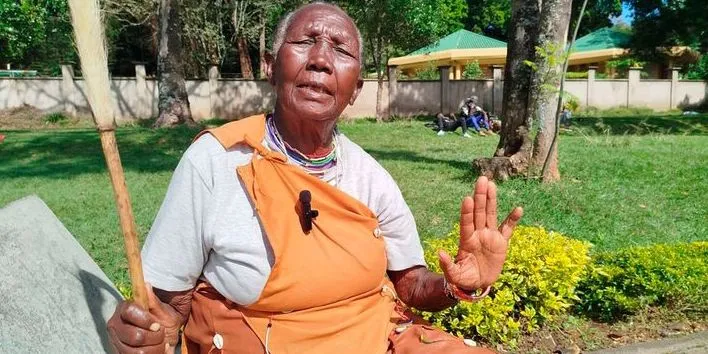
From the era of Kenya's founding father, Jomo Kenyatta, to the leadership of William Ruto, one woman’s voice has echoed through the nation, leaving an indelible mark on its cultural landscape. Elima Chesang, now 74, is a soloist with the renowned Kewamoi traditional dancers, whose career has spanned over five decades, performing for all five Kenyan presidents.
Elima’s journey began in 1968, when she was a young woman with a voice that immediately captured attention. Selected from a pool of talented performers in Baringo North, she was chosen to travel to Gatundu to entertain the founding president, Jomo Kenyatta. “It was no mean feat. Being selected to sing for the President was a great honour for me and my group,” she recalls, her smile reflecting the pride she still feels decades later.
The journey itself was memorable—long, lively, and filled with anticipation. Elima and her choir piled onto a lorry sponsored by the late Baringo North MP, Henry Cheboiwo. For a young soloist from Bartolimo village, this trip marked the beginning of something extraordinary.
Over the next five decades, Elima’s voice became a symbol of cultural pride. She performed for all five Kenyan presidents, consistently showcasing the beauty and depth of traditional Baringo music. Yet today, she lives alone in a rental house in Kaptimbor, on the outskirts of Kabarnet town, without land of her own, reflecting on her life and wondering whether anyone remembers her remarkable contributions.
Elima’s musical talent was evident from her childhood. As a schoolgirl, teachers routinely picked her to lead songs at church services, school events, and pastoral programs. In her community, her voice carried cultural weight, as she sang to encourage girls undergoing traditional rites of passage—her music both a comfort and a rite in itself. “Music is part of me. Even when I am walking or doing chores, I am singing,” she says.
By the time she performed for Jomo Kenyatta, Elima had already established herself as a gifted traditional dancer and soloist in Baringo North, her voice resonating with both authority and emotion. She was married in Kabargoge village, Baringo North, but the marriage broke down in 1974, leaving her to raise four children—three sons and a daughter—on her own. Music became her refuge and her coping mechanism during these challenging years
.
Later, Elima relocated to Kabarnet town in Baringo Central and joined the Kewamoi traditional dancers, a renowned group that would help define her identity as a performer. With the troupe, she refined her craft and solidified her status as a cultural icon. Her performances blended intricate dance movements with powerful vocals, ensuring that Baringo’s rich traditions remained alive and vibrant.
Elima Chesang’s story is more than that of a talented singer—it is a testament to the resilience and cultural pride of Kenyan women. Her voice, which has echoed through decades of national change, continues to remind the nation of the enduring power of tradition, music, and heritage.
Though she lives humbly today, Elima’s legacy endures. Her songs are not just performances; they are cultural landmarks, bridging Kenya’s past and present, and inspiring younger generations to cherish and celebrate their roots.
Elima’s journey began in 1968, when she was a young woman with a voice that immediately captured attention. Selected from a pool of talented performers in Baringo North, she was chosen to travel to Gatundu to entertain the founding president, Jomo Kenyatta. “It was no mean feat. Being selected to sing for the President was a great honour for me and my group,” she recalls, her smile reflecting the pride she still feels decades later.
The journey itself was memorable—long, lively, and filled with anticipation. Elima and her choir piled onto a lorry sponsored by the late Baringo North MP, Henry Cheboiwo. For a young soloist from Bartolimo village, this trip marked the beginning of something extraordinary.
Over the next five decades, Elima’s voice became a symbol of cultural pride. She performed for all five Kenyan presidents, consistently showcasing the beauty and depth of traditional Baringo music. Yet today, she lives alone in a rental house in Kaptimbor, on the outskirts of Kabarnet town, without land of her own, reflecting on her life and wondering whether anyone remembers her remarkable contributions.
Elima’s musical talent was evident from her childhood. As a schoolgirl, teachers routinely picked her to lead songs at church services, school events, and pastoral programs. In her community, her voice carried cultural weight, as she sang to encourage girls undergoing traditional rites of passage—her music both a comfort and a rite in itself. “Music is part of me. Even when I am walking or doing chores, I am singing,” she says.
By the time she performed for Jomo Kenyatta, Elima had already established herself as a gifted traditional dancer and soloist in Baringo North, her voice resonating with both authority and emotion. She was married in Kabargoge village, Baringo North, but the marriage broke down in 1974, leaving her to raise four children—three sons and a daughter—on her own. Music became her refuge and her coping mechanism during these challenging years
.
Later, Elima relocated to Kabarnet town in Baringo Central and joined the Kewamoi traditional dancers, a renowned group that would help define her identity as a performer. With the troupe, she refined her craft and solidified her status as a cultural icon. Her performances blended intricate dance movements with powerful vocals, ensuring that Baringo’s rich traditions remained alive and vibrant.
Elima Chesang’s story is more than that of a talented singer—it is a testament to the resilience and cultural pride of Kenyan women. Her voice, which has echoed through decades of national change, continues to remind the nation of the enduring power of tradition, music, and heritage.
Though she lives humbly today, Elima’s legacy endures. Her songs are not just performances; they are cultural landmarks, bridging Kenya’s past and present, and inspiring younger generations to cherish and celebrate their roots.